Saturday, December 24, 2011

The California Right to Know Genetically Engineered Food Act Submitted to the California State Attorney General

I really hope that this ballot initiative passes in California so that we can have the freedom of informed choice in America. Many countries require labeling of their food if it is genetically modified. Companies could easily label now with little to no increased cost.

All companies would have to do is slap a sticker onto the package that says contains genetically modified ingredients like they often do for sales and specials as part of their marketing strategy. When companies routinely update their packaging information they could add a few words to the package or a symbol specifying that it contains genetically modified ingredients. The only reason companies don't label now is that they want to continue to sell their genetically modified food to unassuming consumers.

We lack the freedom to choose the food we want and are held hostage by the lack of information. In this information age it is amazing that something as simple as the information about the foreign genes in our food is kept secret. I hope that this ballot initiative passes and has little opposition.


Here is the press release.

You can read more about this ballot initiative at this website.

Saturday, December 3, 2011

2012 California Ballot Initiative to Label GMOs

Amazing things are happening that will hopefully turn our food system for the better. A California Ballot Initiative to let voters decide whether they want their food labeled when they are genetically modified is gathering petitions and may be on the 2012 election ballot. Shouldn't we have the freedom to know what is in our food, apparently about 80% of Californians in a poll agreed. It makes sense, many countries label GMO foods, of course then they don't have nearly as many on their shelves as they would otherwise.

We are being held hostage by the corporate food industry and corporate chemical seed companies. We are the customers that buy the food they grow, yet we have very few choices in terms of GMO-free and have no idea what we are eating. It may as well be sewage sludge based on the information offered to the consumer. In deciding on which product to buy many that contain corn, canola, and soybeans are genetically modified with unknown and potentially negative health effects. Let's reject being human guinea pigs in this potentially disastrous experiment.

Here is the official website for the campaign to Label GMOs and here is their facebook page if you are into that. I don't use facebook.

No to GMOs.

Friday, November 18, 2011

A Cold Frame and Winter Gardening

I decided to make a temporary cold frame this winter to test the concept. I built a simple wood frame and used a staple gun to staple 6 mil plastic sheeting to the frame. I wanted to test the idea and work out the kinks, so that I will know the features to include in a more permanent cold frame. I am planning to someday make a more sturdy cold frame with wooden sides and sloped top either with clear glass or plastic. Here are some pictures of my first homemade cold frame and some of the vegetables that we have been eating from the cold frame. It pick from the cold frame about every other day, which is pretty amazing since it gets down below freezing every night. The frame keeps the frost off the plants and warms them to 75F or higher in the day, which initiates strong growth despite the cold night time temperatures. I planted several types of lettuce and a number of other greens.
 1. Lettuces:
    • black seeded simpson
    • paris island cos
    • red sails
    • freckles
    • green and red oakleaf
    • lolla rossa
2. Endive
3. Long Orange Improved Carrot
4. Monstrueux viro flay spinach
5. Fordhook giant swiss chard
6. Cherry belle radishes


    I also have been doing a bit more reading and found that both carrots and parsnips are extremely cold tolerant. I recently planted some of the crop in the ground surrounding the cold frame as it gets warm enough in the day for them to sprout and grow.

    Thursday, September 8, 2011

    Flavor Grenade an Amazing Pluot

    My wife doesn't particularly like fruit. She is more of the meat and veggies type, but pluots are one fruit that she can't pass up. Yes pluots, you know those interspecific hybrids of apricots and plums. She actually doesn't like apricots or plums, but loves pluots for some reason. It gets me. Her all time favorite fruit (a pluot of course) is Flavor Grenade that was bred by the famous Zaiger's Genetics.

    You can see what the trees will grow to look like at this video about the fruit.

    The pluot is distributed through Dave Wilson Nursery. Just look up interspecific plums (pluots) and you can see where they supply the pluot in case you want to order one for your yard like I do. I am thinking that I will need to order it soon to get it this fall or maybe I'll wait a bit to order it for the spring. Maybe in a few years we'll have some delicious Flavor Grenades on a tree of our own.

    Community Supported Agriculture (CSA)

    I stopped by my local CSA/local produce store to see what they had to offer and the prices that they were charging. They stock locally grown food besides the CSA part of their business and they were interested in stocking and selling my seeds and vegetables at their store. I may have to plan to grow something extra to sell this winter. I was planning to make some cold frames and grow radishes, lettuce, peas, and onions for fresh salads all winter. If I make a few extra cold frames, then I can grow a lot more radishes and lettuce to supply the store. I was thinking that I could also start tomatoes in the spring and sell them through their store. I would love to start my own seed business, but now is not the right time in my life to start that venture due to multiple conflicting factors. Maybe in 10-15 years I can start up a real seed business. For now I may just have to build a local reputation and supply some seeds to the local CSA store. Anyway, it might be a good idea to sell through the CSA and make a bit more spending money for the garden.

    Monday, July 11, 2011

    The Best Freeze/Frost Tolerant Peach Variety

    I recently found out about this peach variety called Intrepid that blooms late and has blossoms that are resistant to freezing temperatures. The tree's blossoms have survived freezing temperatures even at full bloom. That is pretty amazing and might make it worth growing peaches in areas prone to late spring frosts. It will survive in zones 4-8.

    I found one place that sells this variety. I am sure that there are others.
    Stark Bro's

    Another variety that came up in my browsing was the Ranger peach. It also is a late bloomer and more winter hardy for northern climates than the Intrepid peach, but is probably not quite as frost resistant in terms of full bloom. It grows in zones 3-7.

    I saw it listed here.
    Sanhedrin Nursery

    I am still interested in trying the White Heath Cling peach and the Indian Iowa White Freestone Peach. I just made peach pie today and boy was it delicious.

    Sunday, May 29, 2011

    Using Dirt Instead of Potting Soil to Start Seeds

    For quite some time I have been a bit disappointed with the traditional store bought potting soil. It presents a few problems when starting seeds.
    1. One is that potting soil often contains a lot of shredded wood which invites fungus gnats to make their abode in your potting soil. The gnats also munch on nice little roots sometimes killing the seedlings. Dirt from outside is usually denser, has less wood particulate for the fungus and gnats to grow, and the dirt seems to deter the fungus gnats.
    2. I have been concerned for some time about the difference in soil environment between the commercial seed starting soil and the real soil that the plants will be growing in the garden. The idea behind potting soil is that it provides the optimal conditions that will allow more seeds to sprout and is sterile so the seedlings will avoid soil borne diseases and be healthier. In the case like mine where I save and start my own seeds I am more concerned about them growing well in my soil. What if the potting soil encourages the growth of certain seedlings over others that may thrive better in my real soil? On occasions in the past where I used commercial seed, I have noticed that many commercial seeds that are typically started early in the season in potting soil don't sprout readily in the open garden soil. I am afraid that these seeds are bred and conditioned to only grow well in the cushy potting soil conditions and are not hardy enough or adapted well enough to grow and survive if planted directly in the ground. Why not plant the seeds in real dirt and let natural selection proceed eliminating the plants that are less tolerant of fusarium wilt and soil borne diseases? Over a few generations of seed saving, the plants should improve their ability to grow in your soil and adapt more perfectly to your real conditions. Starting seeds in sterile potting soil may confound the selection process.
    3. Dirt is Free! Why spend lots of money on potting soil? This was the fundamental changing point for me. I got tired of the high prices for potting soil when similar and possibly better long-term generational results might be obtained with just plain old dirt from my yard.
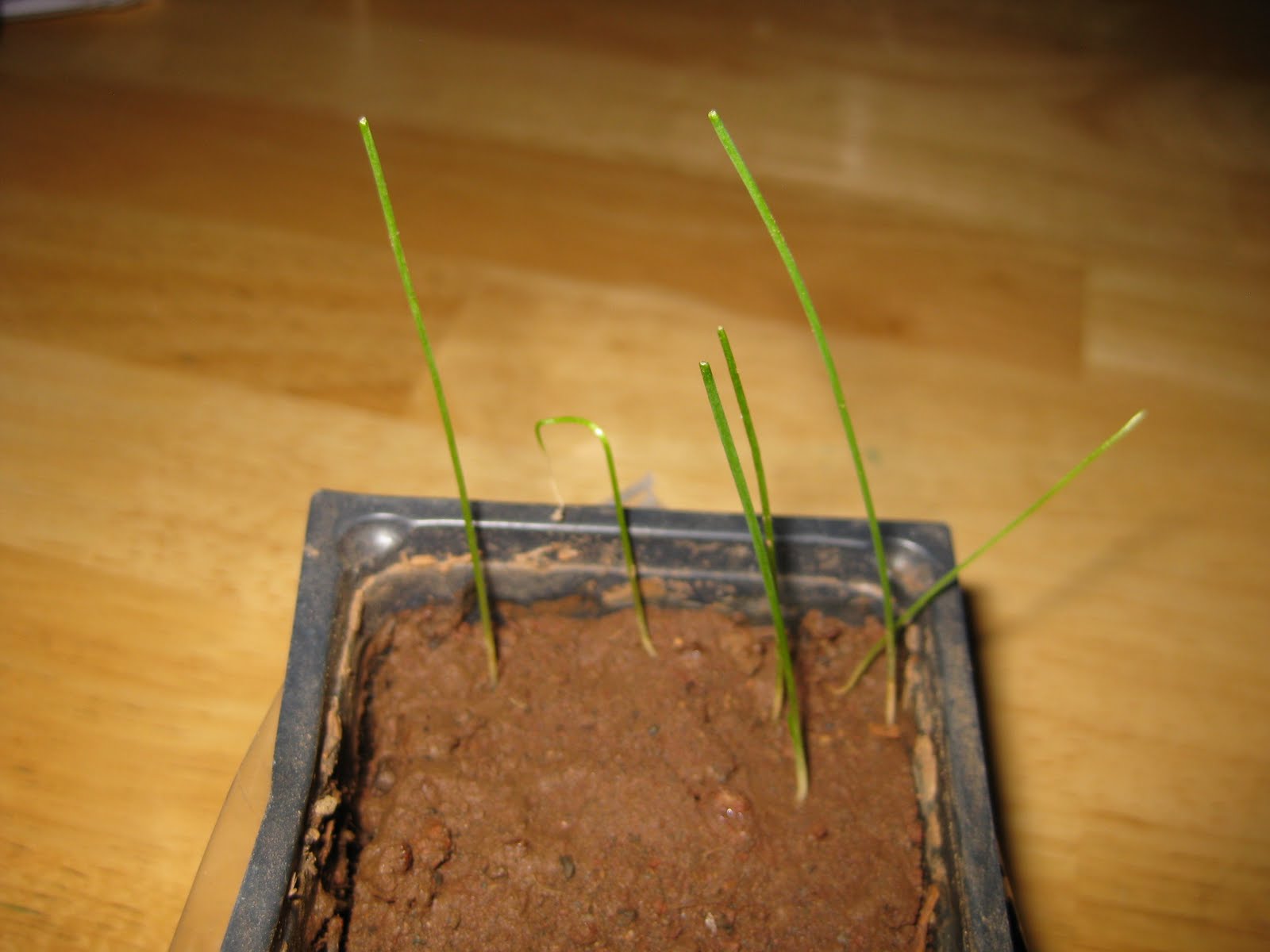
    Here are some pictures of onion starts that I planted last week in just plain dirt from my garden. They seemed to have started to sprout just fine. I expect more to continue to come up over the next week. I am hoping that the weak or poorly adapted seeds don't sprout as I would prefer to select for the hardy onions that are adapted to my soil. It just makes sense to me to start them in the soil that they will be exposed to in the garden.

    Typically it is a good idea to chop onions back to an inch or two, like these below, until you harden them off and plant them outside in the garden.